
Freedom in Motion: Reflections from the Free Cities Conference in Prague
Walking into this year’s Free Cities Conference in Prague, I felt something different from previous years — a sense of maturity and momentum. What began a decade ago as an idea is now a movement with tangible progress, measurable success, and a growing ecosystem of builders determined to create places where freedom is not just discussed but lived.
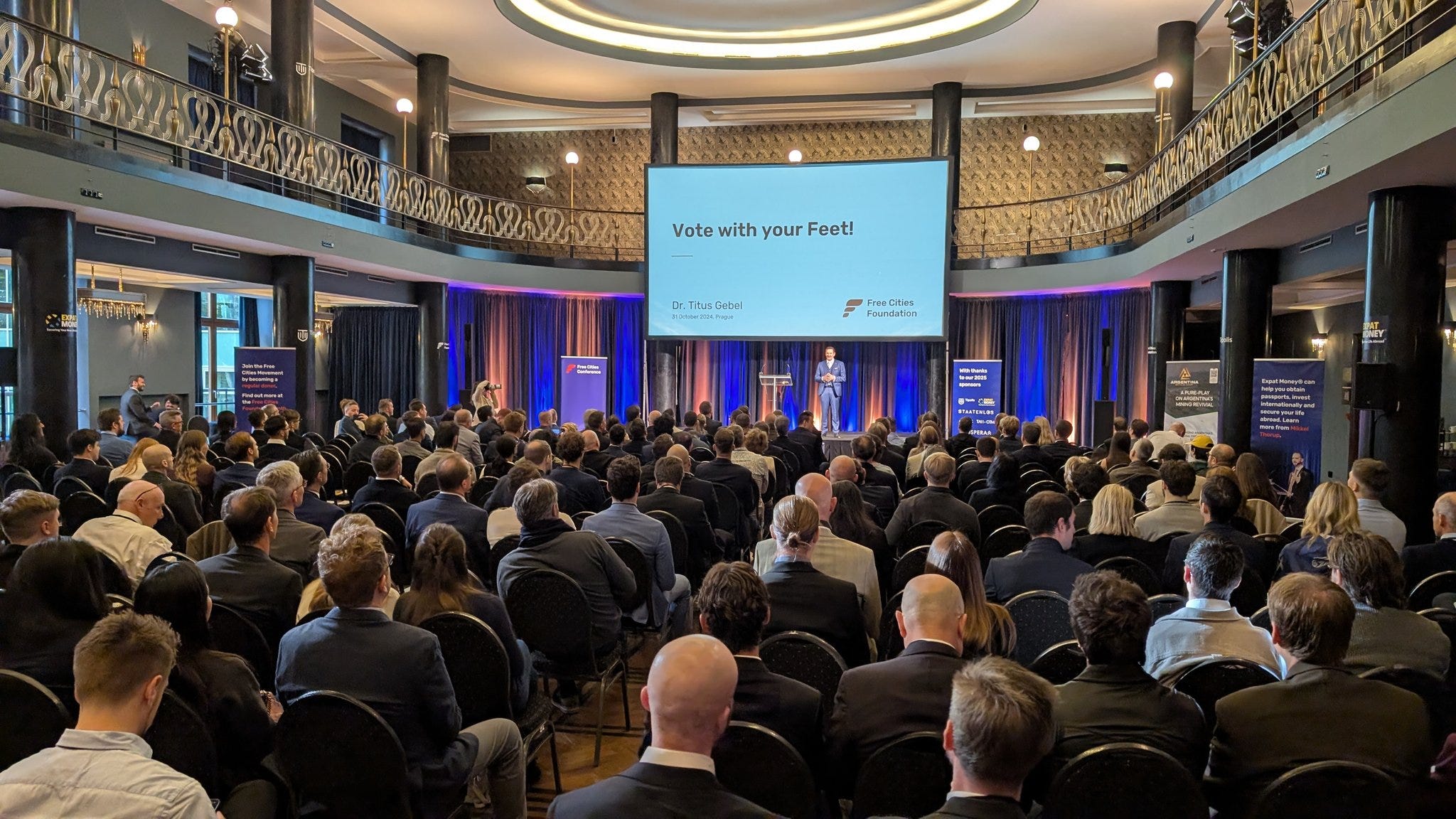
The event ran with precision, professionalism, and enthusiasm. Entrepreneurs, investors, policy thinkers, and pioneers from around the world filled the halls, united not by ideology but by action — by the shared conviction that a freer civilization can and must be built.
From Vision to Implementation
The 2025 theme, Moving for Freedom, captured the spirit of the week. One session featured five people, including me, sharing how and why we moved for greater freedom — not as escapism, but as self-determined migration toward opportunity. Around us, projects once seen as speculative are now operational, and the conversations have shifted from if to how fast.
The updates reflected that transformation. Liberland, founded on land unclaimed by any neighboring nation-state, continues to develop its legal and administrative infrastructure. I also spoke with a founder preparing to establish a new free city on another piece of unclaimed land, this time created by a border dispute — a reminder that even in the 21st century, geography still holds possibilities for those bold enough to act.
Expanding Frontiers — Land, Sea, and Cyberspace
Not all frontiers are on land. Two teams presented ambitious projects to build habitats on the open ocean, using advancing seasteading technology to enable human settlement beyond national jurisdictions. The pace of innovation in ocean engineering has accelerated so quickly that what once seemed futuristic now looks commercially plausible.
Meanwhile, others are focused on digital frontiers. A presentation on using Nostr for sovereign digital identity showed how open-source protocols could make self-ownership practical online — a quiet revolution in how individuals authenticate themselves without reliance on states or corporations.
New Communities, New Pathways
Two organizations showcased services to help people relocate to freer jurisdictions — bridging the gap between today’s constrained world and tomorrow’s decentralized options. They provide everything from legal advice to practical logistics, making it easier for those inspired by Free Cities to take real steps toward living their values.
The conference also introduced new free communities forming in Europe, including a project in Switzerland built around voluntary association and property-based governance. These examples highlight the movement’s diversity — from city-scale developments to smaller intentional communities — all experimenting with the same principle: freedom by consent.
From Network States to Real Estates
Two presentations explored the early stages of network states, the digital-first communities that aspire to evolve into physical jurisdictions. The ideas discussed weren’t utopian theory; they were detailed roadmaps for phased migration — how digital networks can build trust, governance models, and capital long before acquiring land.
Meanwhile, tangible models like Ciudad Morazán continue to demonstrate that private governance can operate within existing legal frameworks. Interest in Morazán has grown so much that a special bonus session was added to the program, where founder Massimo Mazzone presented both the concept and the community’s concrete results to a full room.
As I listened, I was reminded of how far Morazán has come since its earliest days — and how it now stands as proof that voluntary order can function even in a complex legal environment.
Legacies of Autonomy
Few moments captured the human side of freedom more powerfully than when the Princes of Sealand — second and third generations of the world’s smallest sovereign state — took the stage. Their story of defending autonomy in the face of overwhelming odds, often at personal risk, drew both laughter and respect. Their presence reminded everyone that liberty is not merely a theory but a lineage — a living inheritance carried by those who refuse to be ruled.
Similarly inspiring was the presentation on the Live and Let Live movement, which seeks to build cultural foundations for peaceful coexistence. Its message — that mutual respect and personal responsibility must accompany liberty — resonated deeply in a room full of founders and reformers.
Freedom and Finance
Economic independence was another recurring theme. In a world of rising restrictions and capital controls, sessions on investment strategies in an era of capital flight offered practical tools for maintaining mobility and resilience. Entrepreneurs discussed how decentralized finance, private arbitration, and multi-jurisdictional planning are becoming essential to preserving individual sovereignty.
These weren’t abstract conversations. They were strategies for real people navigating a rapidly changing global order — a reminder that freedom is sustained by prudent stewardship as much as passion.
Looking Ahead: The Movement Comes Home
The conference concluded with a historic announcement:
📍 Next year’s Free Cities Conference will be held in an actual Free City for the first time — in Próspera, Honduras.
For many of us, this felt like coming full circle. From early theories of proprietary governance to functioning cities like Morazán and Próspera, the Free Cities movement has arrived at a point where the next logical step is not to talk about freedom, but to host it.
A Civilization in the Making
As I left Prague, I thought about a man I interviewed during the week who told me, “I haven’t found the place where I want to live, so I’ll have to build it.” That single sentence captures the essence of the Free Cities movement — the courage to create rather than complain.
From Liberland’s unclaimed frontier to the ocean’s edge, from digital identities to physical communities, the drive is the same: to reclaim human choice as the organizing principle of civilization.
The Free Cities Conference showed that freedom is no longer a static ideal — it’s in motion, multiplying across borders, seas, and servers.
And as momentum builds, one truth becomes unmistakable:
The age of voluntary civilization has already begun.