
Morazán, December: Building Through Uncertainty
December in Ciudad Morazán felt like living in two timelines at once.
In the national timeline, Honduras was holding its breath through an election that became a referendum on economic direction. In the local timeline, Morazán kept doing what functioning places do: finishing buildings, hitting deadlines, fixing leaks, enforcing contracts, and moving families into homes.
That contrast is the point of Morazán—and of free cities more broadly. When politics becomes a permanent emergency, the most radical thing a community can do is keep its promises.
Honduras in one minute: why this election mattered
For readers outside Honduras, here’s the context you need.
The ruling LIBRE party is socialist and spent its term discouraging the kind of foreign investment Honduras desperately needs. LIBRE also targeted the ZEDE framework—attempting to repeal it, undermine it, and surround it with legal uncertainty.
In the 2025 election, LIBRE was roundly rejected. The early results placed LIBRE far behind, while two opposition candidates—Nasry Asfura (National Party) and Salvador Nasralla (Liberal Party)—ran nearly neck-and-neck, each hovering around 40% as the count unfolded. The uncertainty wasn’t philosophical. It was procedural: the race was close enough that the winner wasn’t announced until December 24.
What matters for Morazán—and for Honduras—is that both leading candidates campaigned on the same practical necessity: attracting foreign investment back into the country. That doesn’t guarantee a friendly environment for ZEDEs, but it does signal something important: the political center of gravity is shifting from ideology toward jobs, capital, and credibility.
Morazán operates inside that reality, but it also stands apart from it. Even as national institutions wobble, Morazán keeps building.
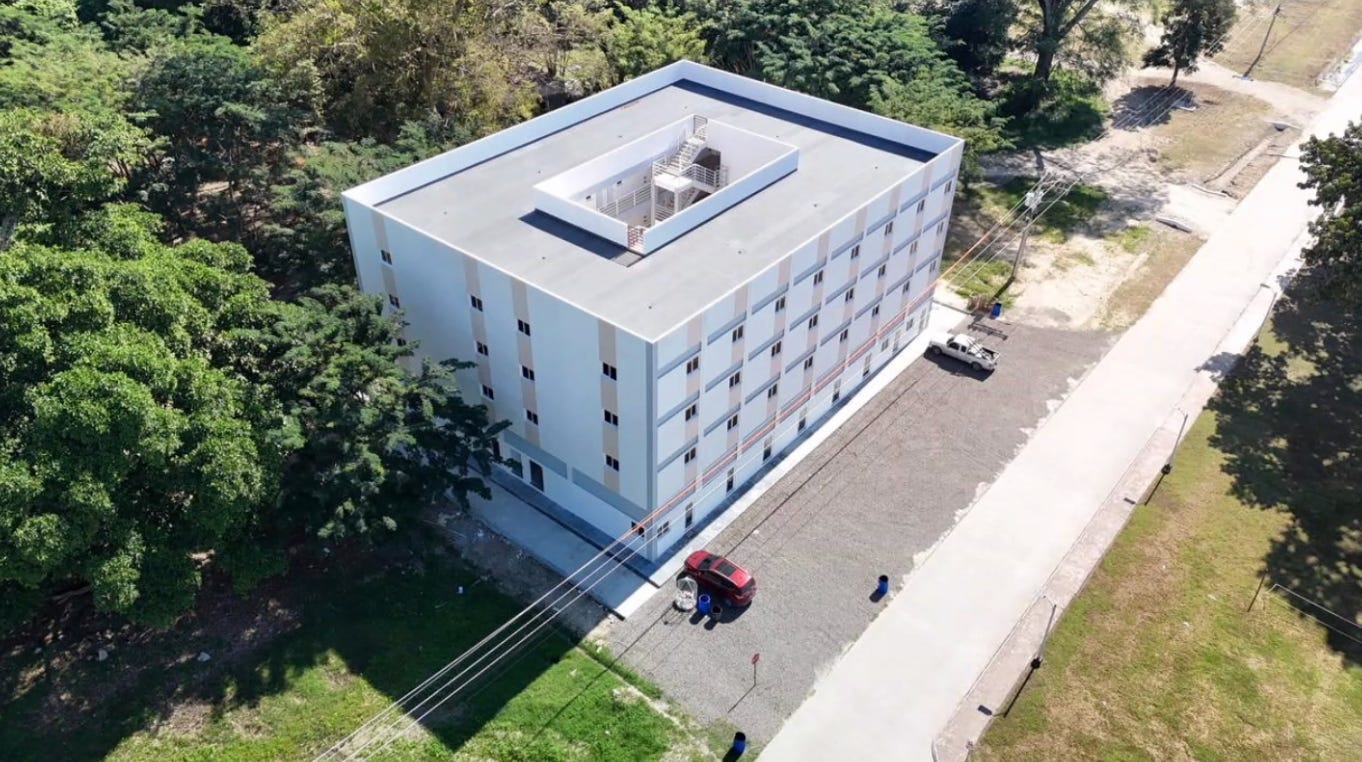
The building: progress made visible… and the unglamorous finish work
At the December 1 weekly meeting, Gerardo reported the new multi-story residential building was nearly complete, with a 2% cost overrun—about $35,000—due to adjustments between additional work performed and work not originally accounted for. Carlos asked for a clear breakdown, and Gerardo committed to provide it.
By mid-month, the exterior was taking its final form: plastering completed on all four sides and security gates installed to restrict access to electrical areas. Inside, the “last mile” list was still alive—commercial-space details and remaining fourth-floor apartments awaiting final delivery.
Construction always tempts you to celebrate too early. What Morazán is learning—sometimes the hard way—is that credibility is built in the finishing details: doors that close, systems that work, and punch lists that actually get cleared.
The school: a deadline with consequences
If the building is a proof of capacity, the school is a proof of purpose.
Throughout December, the school deadline became a high-accountability target. Roof beams went in, plastering advanced wing by wing, floors were poured on schedule, and the team kept returning to the same question: what must be done now to protect the January delivery date?
Deadlines matter differently when the “customer” is education. A school anchors families. Families reduce turnover. Lower turnover turns a housing project into a community.
This is the compounding logic of place: infrastructure → stability → demand → growth.
Reliability: fire, leaks, and the hidden cost of trust
December also reminded everyone that in the developing world, reliability isn’t a “nice-to-have.” It’s the whole game.
On December 4, Ursula informed residents that an emergency had been resolved: a short circuit in the solar battery area. In the December 8 meeting, the cause was traced to a faulty connection that created an electric arc. Replacement wiring and connectors were approved, along with added prevention measures (including alarms and more fire extinguishers).
Leaks were the other recurring villain. Roof issues don’t just damage property; they damage retention. Mid-month brought a meaningful improvement—no leaks reported after rains—followed by a return to technical, warranty-driven fixes in the older blocks and targeted repair schedules when weather allowed.
This is the difference between “we built housing” and “people trust the housing.” Trust is expensive. It has to be earned.
Residents, rents, and the shift toward families
Early December brought a spike in vacancies and enforcement actions. Evictions happened. Outstanding payments were tracked. It was openly acknowledged that the number of vacant units had become uncomfortably high.
Then the pattern shifted.
Marketing and showings increased. Process improvements (including automation for reminders) were prioritized. And strategically, the focus moved toward family stability rather than transient corporate arrangements.
By late December, new tenants included families tied to Millennium School—an example of how education and housing reinforce one another. Apartment occupancy also began to climb. It wasn’t a dramatic “everything is fixed” moment. It was something better: measurable recovery through disciplined operations.
Governance becomes visible in the “small” things
A functioning community is not the absence of conflict. It’s the ability to resolve conflict without turning it into politics.
December was full of quiet governance:
progressive enforcement for parking and contract obligations
handling delinquency and abandoned property through structured procedures
boundary management when municipal actors attempted unscheduled entry
decisions not to renew contracts with chronically problematic tenants
and the steady, unglamorous work of maintaining roads, trees, safety systems, and common areas
None of this substitutes for national reform. But it demonstrates something that politics often obscures: governance can be delivered as a service—through rules, maintenance, enforcement, and care—rather than as a struggle for control.
What December revealed
December didn’t deliver a tidy success story. It delivered something more useful: a clear view of how a free city persists through uncertainty.
Honduras spent the month waiting for an election result—and didn’t know the winner until December 24, when Nasry Asfura was announced. Meanwhile, Morazán kept building anyway.
That is what makes this model powerful.
Not the claim that problems disappear, but the practice of accountability: systems fail, someone owns the failure, the failure is fixed, and the process improves.
In much of the world, residents are trained to expect the opposite.
Morazán is trying to train a different expectation: that promises matter—and that a community can be built by consent, sustained by responsibility, and improved by the daily discipline of doing the work.